
— Introduction to an Esoteric Path —
I was raised Catholic — Mass on Sundays, the rituals of Sacrament, the whole architecture of belief that shapes a Cuban childhood in the 1960s, and later in Franco’s hyper-Christian Spain. I absorbed the Gospels the way one absorbs a language spoken at home: not studied so much as breathed. The stories became furniture of the mind. Familiar, unexamined, present.
What I want to share in this series of daily meditations is something rather different from what I received then — though not, I think, contradictory to it. It is a reading of the same Biblical passages, particularly the Gospels, through the lens of Maurice Nicoll, a Scottish psychiatrist, a student of Carl Jung, and — most crucially for our purposes — a devoted disciple of George Ivanovich Gurdjieff.

Gurdjieff is a figure who resists easy summary. He appeared in Moscow and St. Petersburg around 1912, gathering around him a group of writers, scientists, and seekers with the claim that he possessed knowledge of an ancient and largely forgotten kind — a science of consciousness that had survived in secret among small brotherhoods scattered across the Transcaucasus and Central Asia. He had spent years, perhaps decades, in search of these groups: in Persia, in Tibet, in the Sarmoung monasteries of what is now northern Iraq, in the hidden valleys of the Caucasus mountains where, he suggested, the real inner work of human transformation had been quietly preserved while the outer world forgot it ever existed. In New York City, my father was involved in a Gurdjieff school, and I became a student for years, and acquired a library of esoteric texts that define and extend the consciousness work of Gurdjieff and his students. The work is truly consciousness-transforming with its insights about the world, the self, and mysteries beyond immediate recognition for those who have not studied their own character objectively.

Whether one accepts this body of knowlege and provenance literally or metaphorically matters less than what Gurdjieff actually taught. His central idea was startling in its directness: that human beings, as ordinarily constituted, are asleep. Not metaphorically asleep in some vague spiritual sense, but mechanically asleep — reacting, associating, identifying, spending their lives in a kind of waking dream in which they mistake their habitual thoughts and emotions for a self. He taught that this condition could be changed, but only through sustained, conscious inner work — a discipline of self-observation, of separating the observer from the observed, of cultivating something he called Real Conscience and Real Will, which are quite different from their mechanical counterparts. Deep study of Gurdjieff’s work rewards attention, but this site has a superbly concise deep dive into his work.
Maurice Nicoll encountered Gurdjieff in 1922, spent a year at his Institute for the Harmonious Development of Man in Fontainebleau, and devoted the rest of his life to one overriding question: What is the relationship between this teaching and the inner meaning of the Gospels?
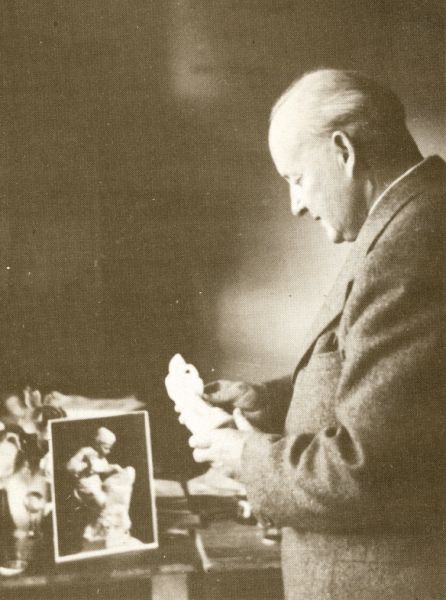
His answer, developed over decades of lectures and crystallized in his book The New Man (1950), was that the Gospels are not primarily a historical record or a moral code — they are a psychological document written in a precise and intentional language of inner meaning. Bread, water, blindness, deafness, sleep, leaven, the seed, the harvest — these are not incidental details or poetic ornament. They are a technical vocabulary describing states of the inner life, the obstacles to its development, and the conditions under which genuine transformation becomes possible.

From this vantage point, many passages that seem cryptic or even contradictory in their conventional reading become luminously clear. When Jesus says the Kingdom of Heaven is within you, Nicoll takes him at his word — not as a future place, not as an institutional promise, but as a present inner state that a human being can enter or fail to enter depending on the quality of his consciousness. When Jesus speaks in parables and his disciples ask why, and he answers that it is given to some to understand and not to others, Nicoll reads this not as theological exclusion but as a psychological fact: certain truths can only be received by a mind that has prepared itself to receive them. The parable is not obscure — it is precise. It is we who are not yet precise enough to read it.
None of this requires abandoning faith, or rejecting the historical Jesus, or dismissing the sacramental life of the Church. What it does require is a willingness to hold the possibility that Jesus was, among other things, a teacher of inner transformation — that his parables, his healings, his encounters with the disciples were aimed at something more specific and more demanding than general moral improvement. That he was trying to awaken something in those around him that most of them, most of the time, did not yet have the eyes to see or the ears to hear.
It is worth noting that Jesus himself repeatedly used exactly that language: He who has ears to hear, let him hear. He was not speaking of physical deafness. He was pointing at a condition — an inner one — that his listeners either possessed or did not. Nicoll spent forty years trying to understand what that condition was, what produced it, and what the Gospels were attempting to cultivate in those willing to work.
Almost every day I will take the readings from the United States Conference of Catholic Bishops (USCCB) daily Mass — the same readings that Catholics around the world hear that morning — and offer a meditation in Nicoll’s spirit and from the depth perspective that he knew transcended ego consciousness. All I can offer is a genuine attempt to read these ancient texts the way he taught: not literally, not allegorically in the loose sense, but psychologically — as precise descriptions of where we actually are and of the direction in which something in us might, with effort and attention, begin to move. Little by little I had to learn to go beyond surface meanings and see the connections meant only for a more aware form of self. I will share this thinking if you care to explore its implications for your own self-understanding. There are many great venues for religious doctrine; don’t read these notes as part of that tradition, and, naturally, no disrespect of other viewpoints is intended.
I do hope you find something useful here. Even — especially — if it disturbs the furniture a little.

